Search This Blog

Monday, 27 February 2012

ZAOU seeks to correct a national anomally

By Andrew Mulenga
2nd year BA Fine Art student Rabecca Mwanza

Since inception, the University of Zambia has had no room for the creative arts as an academic discipline and the country’s scholastic elite continue to look down upon the arts.

Fortunately, about three years ago, the privately owned Zambia Open University (ZAOU) introduced the School of Media, Performing and Fine Arts in an effort to afford individuals in the creative sector to attain professional qualifications at bachelor’s degree level.

Billy Nkunika, the school’s dean and one of only three members of staff who make up the faculty says the school’s operations have been able to progress through the years but it has not all been smooth sailing.

“We have three groups but only two lecturers, it can be quite stressful. But the encouraging thing is that you can see the enthusiasm in the students, our students are really trying to put in all the best under the circumstances” he says.

Lecturer William Miko
guides a student
Konica says apart from the challenge of material inputs, studio and theatre space for the students is an urgent requirement although there are silent plans by the universities administration to construct the same, it does not seem to be placed as a matter of priority. Currently, the art students borrow space at the Lusaka National Museum for two weeks of residential school once a year; this is the only time the students are in full, practical contact with their lecturers.

And Amanda Chabeba a first year Bachelor of Fine Arts student from Ndola who was in Lusaka for two weeks annual residential school says the course was interesting but too hectic because of the limited time that constitutes the nature of the distance learning progrmme.

“We have been given work to take home. We are back in June for exams and we will bring back the assignments that we have been given,” she says “But anyway I am still excited at the opportunity because I have been looking forward to studying for a degree in art ever since I graduated from Evelyn Hone College”.

Amanda, who teaches grades 8 and 9 at Dag Hammerskjoeld basic school in Ndola is disappointed however that art students are the most under rated at ZAOU. She observes that students in other disciplines took their residential school at the Copperbelt University, whereas the art students had to squat with friends and relatives for the duration of their residential school.

And Nickson Alitili a first year student who decided to take up art after reading several articles on contemporary art in the Weekend Post.

“The course is a blessing to me and it will go a long way in enhancing the passion that I have for the arts. But we still lack in certain areas, I thought the university will come in and help us with easels and other equipment, they really have to improve on the infrastructure”.

Nickson also explains that due to the distance learning nature of the programme, as first years they are totally detached from their seniors who go for residential school at different periods.

“There are times when you need advise on certain issue and can’t get it. Maybe if we could have some student’s blog, or a portal, that could help,” he says “I also think it would be good to have a residential school in the middle of the year not just exams”.

In addition, William Miko, the school’s only fine arts lecturer says introducing the programme is merely an attempt to “correct a national anomaly”.

“Why subsequent governments have not paid attention to establishing a school I cannot answer. As for the current government, they have pronounced the establishment of at least 6 universities so far,” he says “But I doubt if any of them will have a faculty of arts and culture to be at par with many universities surrounding us in the region”.

Miko says the distant learning method of the art school at ZAOU may be the school’s major challenge because art is a technical subject that requires what he describes as face to face or contact hours with students.

“We have students coming in from as far as Chiyengi, Kabompo, Solwezi and Livingstone, this should tell you how much people have been looking forward to such a programme in the country”, he says “In my own view this is something that has been a conspicuous missing element in the development of arts and culture in Zambia. That’s why it is perhaps reflective of the lip-service that government pays to the arts.”

He says because artists have not been developed to degree level they are not able to assert themselves at high level symposia on the international stage.

“When it comes to administration in talent-based institutions, the petty squabbles that you find in NAC or Football Association of Zambia (FAZ) you will not find them in Law Association of Zambia (LAZ) or Engineers Association of Zambia (EAZ) because they have minimum levels of education at degree level” declares Miko “You will find them scrounging for little allowances here and there, that’s because their thinking capacity hasn’t been expanded to the highest levels”

He is hopeful that the government will try and rectify the issue of arts administration as soon as possible.

“As it is now, even in the government ministerial structure the arts are still scattered everywhere, why? Because people at cabinet office don’t know that to do with the arts, and you cant blame them”

Miko also regrets the fact that Religious Education and Physical Education teachers with degrees have now been given the responsibilty of supervising and marking art examination papers and the sooner ZAOU can churn out teachers with degrees in arts the better, so that they can assume their rightful position in this regard.

No more ‘lip-service’ govt promises the arts

By Andrew Mulenga
Germain Gamiet, Mulenga Kapwepwe
and Keith Mukata
The National Arts Council of Zambia (NAC) last week hosted a “first of its kind” business breakfast at Mika Hotel in Lusaka, with the intention of creating a platform for dialogue between government, the corporate community and the arts fraternity.
While the arts fall under the Ministry of Chiefs Affairs in the present government, NAC instead resolved to call uponthe Minister of Commerce Trade and Industry, Robert Sichinga as guest of honorto explain the government ‘s vision ­­for developing the arts sector as a contributor to national wealth and employment creation. Sichinga however was unable to attend and instead, deputy minister Keith Mukata took his place.
NAC also invited a number of business executives to the mining sector to attend in the hope that the government would encourage them to take up a role in collaborating with and supporting the arts to mutual benefit.
On behalf of government, the deputy minister emphasized the importance that needed to be attached to the development of the arts.
“In fact this meeting could not have come at a better time than now, for a long time the arts sector in this country has only received lip service, with artistes struggling on their own, with little or no support,”he said “The PF government is in a hurry to develop the country and we intend to do so in all sectors, including the arts”.
Addressing the meeting, he advised members of the business community that investing in the arts can be a very lucrative business. He pointed to the Hollywood, Bollywood and Nollywood film industries as some good examples of how the creative industry can not only create revenue and contribute to a nation’s economy, but that the sector can also be viewed as a nation’s flag carrier.
“I am aware that some foreign companies in Zambia spend a lot of money promoting their corporate image using foreign artistes to create TV and radio advertisements. If we invest in ourartistes, this can change” said Mukata “The truth is that companies will always depend on the arts to promote their corporate image, we should therefore get involved in the sectors development”
He added that PF was well aware of the challenges Zambian artistes were facing and thanked them for continuing to remain resilient.
“I believe it is now time to put resources which can help transform the sector into one that will create wealth and employment,” he said “It is also the PFs intention to continue supporting institutions like NAC so that they can carry on giving direction in the promotion of the arts.”
He said government will strive to create a conducive and attractive environment for investing in the individual artiste and the creative sector as a whole.
“The ministry of commerce trade and industry through the patents and companies registration agency has formulated a national intellectual property policy aimed at encouraging investors, inventors, innovators and creators to work diligently knowing well that their works will not only give them benefits in form of recognition and royalties but also contributing to national development,” said Mukata.
And officiating at the function, NAC Chairperson Mulenga Kapwepwestressed that it was about time artistes learned how to interface with government and the business community and that the breakfast meeting was just the beginning of this process.
 “We artistes also realized that we don’t know how to speak to the business people in an effective way for mutual benefit of both parties. So we thought we better start talking”, said Kapwepwe.

Opinion
The three-way relationship that NAC intends to foster vis-a-vis arts-governments-corporate is all but none existent in Zambia; in fact regime after regime, corporate and public support of the arts has consistently plummeted.But following the deputy minister’s remarks it would be important for artistes to therefore put government under the spotlighton how they will implement supporting of the arts sector, even if it means using the newly formulated national intellectual property policy.
As the deputy minister emphasised in his own words that the arts sector has been “lip-serviced” for too long, artistes should not relax but take government on, and one only hopesMukata’swords were not merely a continuation of the “lip-service” he so much criticised.
Nevertheless economic and creative landscapes such as South Africa, however enjoy a much more profound relationship between government, the arts and business houses, with almost all the major banks owning large art collections or sponsoring arts prizes and festivals.
Of course the South African corporate and arts landscape dwarfs that of Zambia, and it (South Africa) has policy white papers in favour of the arts that Zambian’s for now can only dream of.But in Zambia too there is obviously room for the business community to support the arts. Just as well NAC invited Germaine Gamiet from Business Arts South Africa (BASA)a nonprofit company whose primary aim is to promote mutually beneficial and sustainable business-arts partnership that will benefit society as a whole to the indaba.
Gamiet made a presentation on the working relationship between the South African business sector, government, artistesand civil society. He also highlighted the economic, financial and corporate social responsibility benefits the South African business sector enjoys through sponsorship and support to arts programmes.
It is not clear whether NAC intends to follow the South African model and formulate a ‘Business Arts Zambia’ that will see CEOs sitting on a board for the arts, however, the breakfast meeting is aching for a follow-up in which NAC can suggest an arts calendar or possible areas of partnership and support to the Zambian business community.During the meeting Finance Bank Executive Director, Corporate , Retail Banking and Marketing - Helen Lundaraised the issue of corporates being interested in supporting the arts but not knowing where, or how to direct the funding, and rightfully so.Following the high profile breakfast it would be good to see less formalmeetings where business executives can meet the actual artiste and not the arts administrator can meet in an indaba to share and brainstorm on the possibilities of investment and support of the arts by having the executives meet face to face with the artists in their own territory.
All in all, with a government that is declaring no more “lip-service” towards the arts, it is an opportunity for NAC to entice them and the corporate sector to support the now shambolic Ngoma Awards, which according to sources could not take place last year because of resources, political will and uncertaintywithin the ranks of the arts council as they had no clue to which side the political hammer will fall late last year. Winning an art award should be a life changing momentboth inspirationally and financially, the prize money given to artistes for the Ngomas being about K1.5m is nothing short of a joke. With proper coaxing of business houses and government, an artiste should be able to walk home with at least a K50m cash prize. For now, nonetheless it appears the ball is in NAC’s court.

Wednesday, 21 December 2011

Africa’s share of global arts economy less than 1%


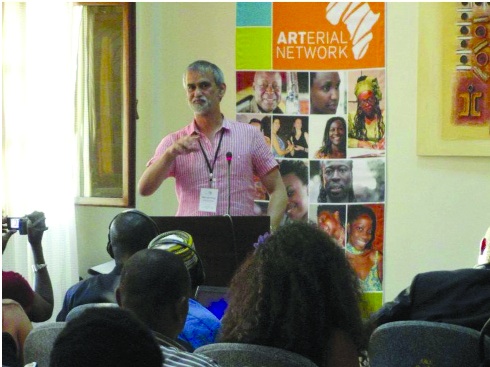
Executive Director of the African Arts Institute and
Arterial Network secretary general Mike van Graan
speaking in Nairobi - (Pictures courtesy Thabiso Mashaba)

By Andrew Mulenga

The first conference on the African Creative Economy which took place in Nairobi recently was attended by more than 120 delegates representing 36 countries.
Running from December 4 to 7, the conference interrogated arguments such as "Assessing markets in the global south", "The contribution of the creative economy to African cities and the potential for an African creative cities network", The Millennium Development Goals (MDGs): development, culture and the creative industries and Reducing dependency among other things.
Organised by the Arterial Network,  a continental network of artists, cultural activists, arts NGOs,  the event was the first of what is planned as an annual conference that rotates from region to region. The Conference also coincided with the election of a new continental steering committee for Arterial seeing Ghana's Korkor Amarteifio take over the reigns from Zambia's Mulenga Kapwepwe.
Highlighting the purpose for having such a conference to start with, Arterial Network Secretary general Mike van Graan, who is also executive director of the African Arts Institute based in Cape Town observed "By understanding the creative economy, we as artists hope to understand how our creative practice may be more sustainable, how we might generate the income we need to pay our rent, put bread on the table, prepare for our old age, etc."
In a presentation entitled "The creative economy, development, culture, human rights and democracy in Africa: joining the dots", van Graan stated "There are at least five possible answers as to why a conference on the creative economy should be held in the first place, and those are Economic, Developmental, Political, Strategic/advocacy and Sustainability".
On Economy he stated: "Over the last 30 years, the creative industries have made major contributions to national and regional economies in the global north with Japan, the USA, China, the UK and Germany accounting for more than 50 per cent of global exports in the creative sector. With Africa’s share of global trade at just over 2 per cent and its share of the global creative economy at below 1 per cent, the creative industries are promoted as areas of potentially huge growth that will boost Africa’s global trade position. And yet, we have to ask: if the creative industries are such major contributors to economic growth and job creation in the north, why is the sector facing such dramatic cuts in Europe at the moment?"
As for development, van Graan observes on a more positive note that the 2015 deadline for the Millennium Development Goals - most relevant to Africa - is fast approaching and the creative economy is being advanced as a key contributor to the economic growth believed to be necessary to realise the MDGs.
On his third and political assessment he observes that: "Embedded in creative products are ideas, world views, aesthetics and values so that as primary importers and consumers of television, movies, literature, music, etc, we in Africa imbibe these, assuming the values, aesthetics and perspectives of others, thereby eroding our own identities and cultural traditions in the process. Thus are we challenged to project our perspectives into the global market of ideas, to have a creative voice that will speak our stories, assert our perspectives, share our values through creative products."
On strategy and advocacy, he observes that "given the lack of support for the arts by African governments who generally deem it a luxury in the context of other development or vote-catching needs, we in the arts community believe that by showing the economic impact of the arts, politicians will be better disposed towards investing in the arts."
In conclusion, van Graan states given the conditions on the African continent, the challenges with regard to development, the challenges of democracy and human rights, the challenges of poverty and inequity, Africa's starting point, in his view, should not be economic growth or development, but rather human rights and freedoms, and a pursuit of creative industries and the creative economy should be to serve human rights and freedom, rather than have these fundamental rights subservient to economic growth.